Vòng chung khảo · Giải thưởng Khoa học và Công nghệ dành cho sinh viên năm 2026Finalist · 2026 Science and Technology Award for University Students
HCMUT URA Research Group

ViR3QA

Vietnamese Retrieval · Reasoning · Reliable QA

Bộ chuẩn đánh giá thống nhất, tái lập được cho truy hồi thông tin và hỏi đáp tiếng Việt đa lĩnh vực, từ suy luận đa mức độ đến trả lời đáng tin A Unified, Reproducible Benchmark for Multi-Domain Vietnamese Information Retrieval and Question Answering, Spanning Multi-Level Reasoning to Trustworthy Answering

Long S. T. Nguyen1,2 · Tho T. Quan1,2

1Nhóm nghiên cứu URA, Trường Đại học Bách khoaURA Research Group, Ho Chi Minh City University of Technology (HCMUT)   2Đại học Quốc gia Thành phố Hồ Chí MinhVietnam National University Ho Chi Minh City

14bộ dữ liệu hợp nhấtunified datasets
6bộ dữ liệu mớinew datasets
15.000+15,000+câu hỏi thực tếreal-world questions
5 × 16họ phương pháp × mô hìnhparadigms × models
5bài báo quốc tếinternational papers
Tổng quanOverview

Tóm tắtAbstract

Hỏi đáp dựa trên truy hồi (RAG) đang là nền tảng của các trợ lý trí tuệ nhân tạo. Với tiếng Việt, dữ liệu lại phân mảnh: mỗi bộ một định dạng, một cách chia tập, một độ đo, nên kết quả khó so sánh và khó tái lập. Phần lớn tài nguyên chỉ có câu hỏi một bước và mặc định câu hỏi luôn rõ ràng, luôn có đáp án.

ViR³QA là bộ chuẩn thống nhất đầu tiên cho truy hồi thông tin và hỏi đáp tiếng Việt. Đề tài hợp nhất 14 bộ dữ liệu thuộc 6 lĩnh vực về một lược đồ và một giao thức đánh giá, tổ chức theo ba trục: lĩnh vực, mức suy luận (một bước, đa bước, theo tình huống) và tính trả lời được (chuẩn, mơ hồ, không có đáp án). Trục thứ ba lần đầu được đo như một năng lực riêng.

Đề tài xây mới sáu bộ dữ liệu từ nguồn thật, khảo sát 5 họ phương pháp truy hồi trên 16 mô hình, và đề xuất hai hệ thống đạt kết quả tốt nhất: truy hồi theo đồ thị đa tác tử cho suy luận đa bước, và URASys cho trả lời đáng tin. Toàn bộ dữ liệu, mã nguồn và giao thức được phát hành mở.

Retrieval-Augmented Generation (RAG) is the backbone of modern AI assistants. For Vietnamese, however, resources are fragmented: each dataset has its own format, split and metrics, so results are hard to compare or reproduce. Most resources contain only single-hop questions and assume every question is clear and answerable.

ViR³QA is the first unified benchmark for Vietnamese IR and QA. It consolidates 14 datasets across 6 domains under one schema and one evaluation protocol, organized along three axes: domain, reasoning level (single-hop, multi-hop, situation-based) and answerability (standard, ambiguous, unanswerable). Answerability is evaluated as a first-class axis for the first time.

We build six new datasets from real-world sources, benchmark five retrieval paradigms over 16 models, and propose two systems with the best results: a graph-based multi-agent retriever for multi-hop reasoning and URASys for reliable answering. All data, code and protocols are publicly released.

TL;DR: ViR³QA hợp nhất 14 bộ dữ liệu tiếng Việt thành một bộ chuẩn đo cả ba năng lực tìm đúng, suy luận đúng và trả lời đáng tin, kèm hai hệ thống đạt kết quả tốt nhất.ViR³QA unifies 14 Vietnamese datasets into one benchmark that measures retrieval, reasoning and reliable answering, with two systems that achieve the best results.
Mục tiêuGoals

Ba câu hỏi nghiên cứuThree Research Questions

Mỗi câu hỏi ứng với một trụ của bộ chuẩn, và được trả lời bằng thực nghiệm trên cùng một giao thức.Each question maps to one pillar and is answered experimentally under the same protocol.

R1 · Truy hồiRetrieval

Phương pháp nào tìm đúng tài liệu tiếng Việt?Which retrieval method works best for Vietnamese?

Lai ghép từ khoá và ngữ nghĩa đứng đầu ở cả 10 bộ dữ liệu.Lexical–semantic hybrids win on all 10 datasets.

R2 · Suy luậnReasoning

Hệ thống có nối được bằng chứng từ nhiều văn bản?Can systems connect evidence across documents?

Có, khi lần theo quan hệ giữa các văn bản: F1 đạt 0,833.Yes, by following inter-document relations: F1 0.833.

R3 · Đáng tinReliable

Hệ thống có biết hỏi lại và biết từ chối?Can systems ask back and abstain?

Có: URASys đúng 85,0%, vượt GPT-4o, Gemini và Claude.URASys reaches 85.0%, beating GPT-4o, Gemini, Claude.

Chạy thửRunning example

Hệ thống xử lý những câu hỏi khó như thế nào?How do the systems handle hard questions?

Chọn một trong hai hệ thống đề xuất và một câu hỏi mẫu. Khung đồ thị cho thấy dữ liệu đi qua những thành phần nào; khung dưới là nhật ký từng bước, đến câu trả lời cuối cùng.Pick one of the two proposed systems and a sample question. The graph shows which components the data flows through; the log below records each step up to the final answer.

URASys · Interactive QA

Hội thoại minh hoạ, dựng lại theo cách hệ thống hoạt động được mô tả trong các bài báo; câu hỏi lấy từ các bộ dữ liệu.Illustrative sessions reconstructed from the system behavior described in the papers; questions come from the datasets.

Thiết kế bộ chuẩnBenchmark design

Ba trục, một giao thức, một lược đồThree axes, one protocol, one schema

Mười bốn bộ dữ liệu khác định dạng được đưa về cùng một lược đồ, nên mọi phương pháp được đo trên cùng một thước.Fourteen heterogeneous datasets are mapped to one schema, so every method is measured with the same ruler.

Mỗi câu hỏi được định vị theo ba trụcEvery question is placed on three axes

  • Lĩnh vực:Domain: giáo dục, chăm sóc khách hàng, y tế, pháp luật, đời sống, tri thức mở.education, customer support, healthcare, legal, lifestyle, open knowledge.
  • Mức suy luận:Reasoning level: một bước → đa bước (1–5) → theo tình huống.single-hop → multi-hop (1–5) → situation-based.
  • Tính trả lời được:Answerability: chuẩn · mơ hồ · không có đáp án.standard · ambiguous · unanswerable.
{ query_id, query, domain, reasoning_level,
  hop_count, answerability, relevant_context_ids,
  evidence, answer }

Một lược đồ chung cho cả 14 bộ; cấu hình cố định, mã nguồn và bảng xếp hạng công khai.One schema for all 14 datasets; fixed configurations, open code and leaderboard.

Điểm mới so với tài nguyên hiện cóWhat is new compared to existing resources

Tài nguyênResourceLĩnh vựcDomainNguồn dữ liệuSourceĐa bướcMulti-hopKhông đáp ánUnanswerableMơ hồAmbiguousVăn nóiInformalGiao thức chungUnified protocol
UIT-ViQuAD 2.0 [15]Tri thức mởOpenWikipediaWikipedia✗✓✗✗✗
ViMQA [16]Tri thức mởOpenWikipediaWikipedia✓✗✗✗✗
UIT-ViNewsQA [19]Y tếHealthcareBáo sức khoẻ trực tuyếnOnline health news✗✗✗✗✗
ViMedAQA [20]Y tếHealthcareTài liệu y khoa trực tuyếnOnline medical documents✗✗✗✗✗
ALQAC [17]Pháp luậtLegalVăn bản luậtStatute law✗✗✗✗✗
Zalo Legal [18]Pháp luậtLegalVăn bản luậtStatute law✗✗✗✗✗
ViRHE4QA [23]Giáo dụcEducationQuy chế đại họcUniversity regulations✗✗✗✗✗
VlogQA [21]Đời sốngLifestyleLời thoại videoVlog transcripts✗✗✗✓✗
ViRe4MRC [22]Đời sốngLifestyleĐánh giá sản phẩmProduct reviews✗✗✗✓✗
ViR³QA6 lĩnh vực6 domainsCâu hỏi thật, văn bản chính thứcReal questions, official documents✓✓✓✓✓
Dữ liệuData

Khám phá sáu bộ dữ liệu mớiExplore the six new datasets

Chọn một bộ để xem thống kê, phân bố và một mẫu dữ liệu đầy đủ trường theo lược đồ chung.Pick a dataset to see its statistics, distribution and a full-field sample in the unified schema.

Cùng 8 bộ công khai (UIT-ViQuAD 2.0, ALQAC, ZaloLegalQA, ViMedAQA, ViNewsQA, VlogQA, ViRe4MRC, ViRHE4QA) được chuẩn hoá về cùng lược đồ, tổng cộng 14 bộ.Together with 8 public datasets (UIT-ViQuAD 2.0, ALQAC, ZaloLegalQA, ViMedAQA, ViNewsQA, VlogQA, ViRe4MRC, ViRHE4QA) normalized to the same schema: 14 datasets in total.

Thiết lập thực nghiệmExperimental setup

Hơn 40 phương pháp và mô hình trên cùng một mặt bằng40+ methods and models on one common ground

Cùng dữ liệu, cùng mô hình nền, cùng giao thức đánh giá, nên mọi so sánh đều công bằng và tái lập được.Same data, same backbone, same protocol, so every comparison is fair and reproducible.

Bảng tự chuyển sau vài giây; bấm để chọn. Số liệu lấy từ bài báo IJCNLP-AACL 2025 và ACIIDS 2026.Boards rotate every few seconds; click to choose. Numbers from the IJCNLP-AACL 2025 and ACIIDS 2026 papers.

Kết quảResults

Kết quả nổi bật từ năm bài báoHighlights from the five papers

Mỗi bài báo một câu hỏi nghiên cứu, một con số then chốt và một biểu đồ so sánh với các phương pháp đối chứng.Each paper: one research question, one key number and one chart against the baselines.

Bảng kết quả đầy đủFull results

Năm bảng số liệu gốc trong các bài báo, gồm đủ các phương pháp đối chứng.Five original tables from the papers, with all baselines included.

Tổng hợpSynthesis

Sáu phát hiện khoa họcSix key findings

Rút ra trên cùng một mặt bằng đánh giá, nên so sánh được và tái lập được.Drawn on one shared evaluation ground, so they are comparable and reproducible.

01
R1 · Truy hồiRetrieval

Lai ghép là mặc định tốt nhấtHybrid is the best default

Kết hợp từ khoá và ngữ nghĩa thắng ở cả 10 bộ, trọng số tối ưu 0,6–0,8.Lexical + semantic wins on all 10 datasets, optimal weight 0.6–0.8.

02
R1 · Truy hồiRetrieval

Quy mô không quyết địnhScale is not decisive

Mô hình 9,2 tỉ tham số không vượt mô hình nhỏ; mô hình đa ngữ cỡ vừa ổn định nhất.A 9.2B model does not beat small encoders; mid-size multilingual models are most robust.

03
R1 · Truy hồiRetrieval

Không dùng nguyên công thức tiếng AnhEnglish recipes do not transfer

SPLADE và ColBERT chưa tinh chỉnh thua cả BM25 trên tiếng Việt.Off-the-shelf SPLADE and ColBERT lose to BM25 on Vietnamese.

04
R2 · Suy luậnReasoning

Suy luận sâu cần cấu trúcDeep reasoning needs structure

Tỉ lệ sai tăng từ 15,3% lên 94,1% theo số bước; đồ thị vượt xa truy hồi phẳng.Error rises from 15.3% to 94.1% with hops; graphs far exceed flat retrieval.

05
R3 · Đáng tinReliable

Đáng tin là năng lực riêngReliability is its own skill

Các hệ phổ biến chỉ đúng 9–14% ở câu không có đáp án; khả năng hỏi lại và từ chối tạo khác biệt lớn nhất.Common systems score 9–14% on unanswerable; asking back and abstaining make the biggest difference.

06
Cả ba trụAll pillars

Văn nói là thách thức lớn nhấtInformal text is the new frontier

MRR@10 đạt 96,7 với văn bản luật nhưng chỉ 18,2 với bình luận đời thường.MRR@10 reaches 96.7 on legal text but only 18.2 on everyday reviews.

Phương phápMethods

Hai hệ thống đề xuấtTwo Proposed Systems

Mỗi hệ thống giải quyết một trụ khó nhất của bộ chuẩn: suy luận đa bước và trả lời đáng tin.Each system targets the hardest pillar it addresses: multi-hop reasoning and reliable answering.

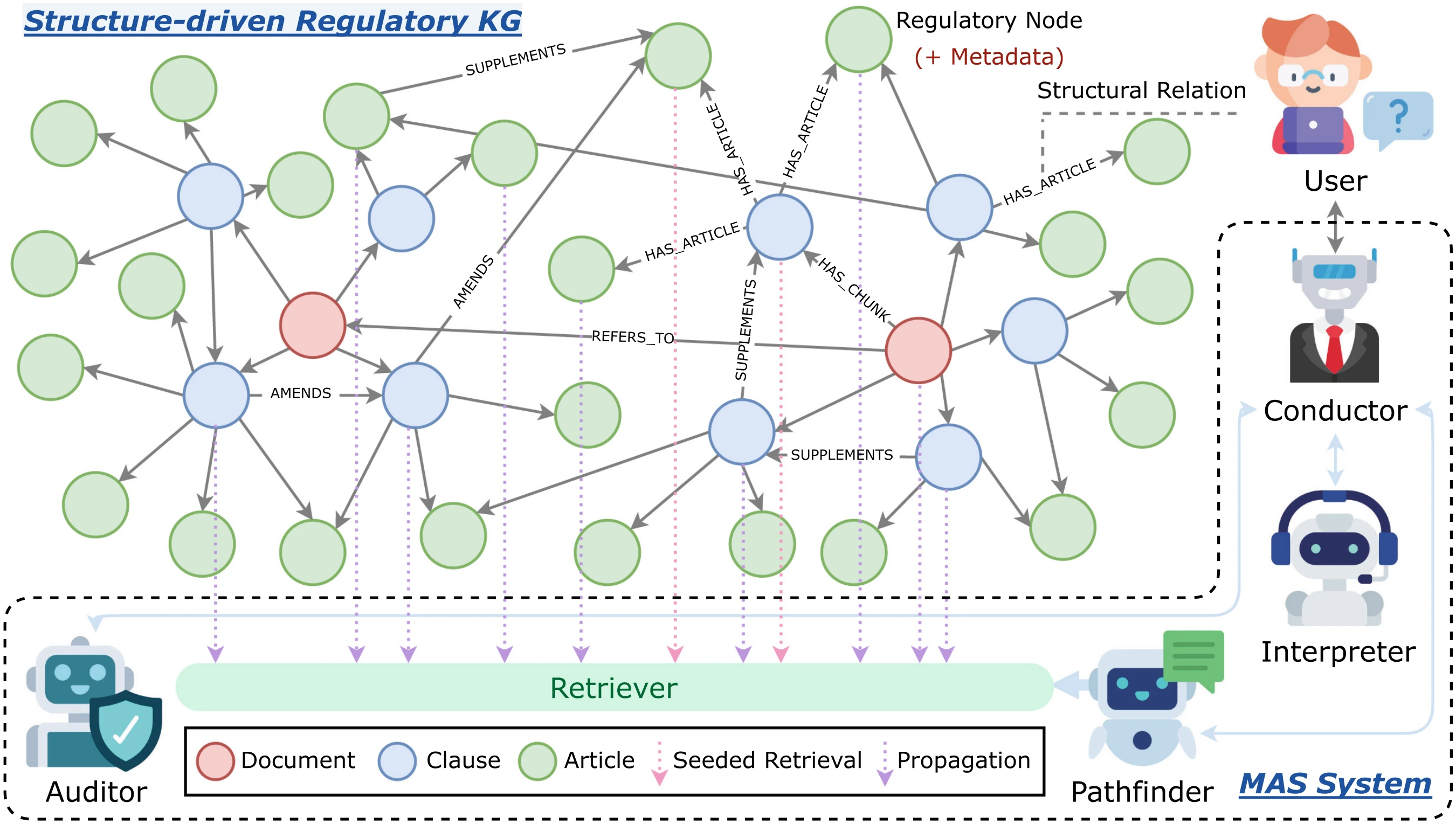
Truy hồi theo đồ thị tri thức quy phạm, đa tác tửGraph-based multi-agent retrieval over regulatory knowledge ACIIDS 2026

Graph-based multi-agent system
Interpreterphân tích ý định, nhận diện văn bản được nhắc tớiunderstands the query and referenced documents
Pathfinderlần theo quan hệ Sửa đổi, Thay thế, Bổ sungfollows Amend, Replace, Supplement relations
Auditorkiểm tra trích dẫn và ngày hiệu lựcverifies citations and effective dates
Conductortổng hợp, hỏi lại hoặc từ chối khi thiếu căn cứsynthesizes, asks back or abstains when unsupported
0,8330.833F1 · cao nhất trong 9 hệ thốngbest of 9 systems
0,8460.846Recall@5 · cao nhấtthe best
14,7 s14.7 snhanh hơn HippoRAG 2 (22,0 s)faster than HippoRAG 2 (22.0 s)
0,833 → 0,6540.833 → 0.654F1 khi bỏ InterpreterF1 without the Interpreter

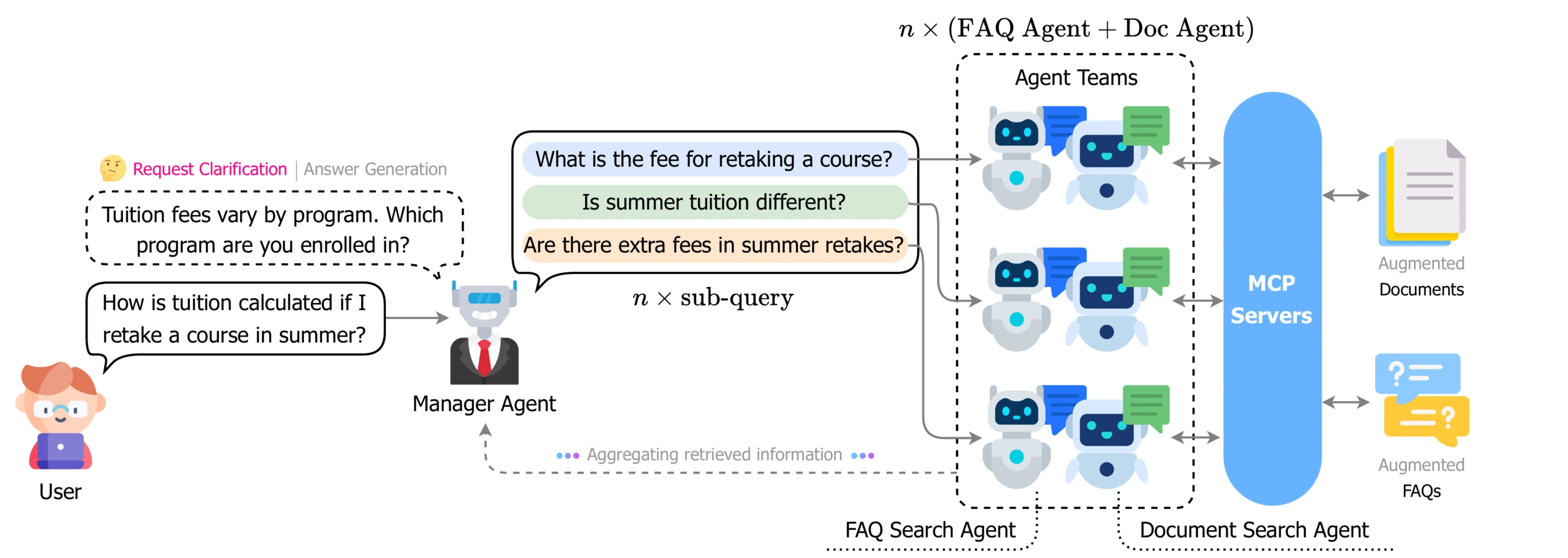
URASys · Khi chưa chắc, hãy hỏi trướcWhen in Doubt, Ask First IJCNLP-AACL 2025

URASys architecture
Nguyên tắc vừa đủJust Enoughchỉ trả lời khi đủ bằng chứng và rõ ý địnhanswer only with sufficient evidence and clear intent
Chỉ mục hai phaTwo-phase indexingchia đoạn kèm tiêu đề, rồi sinh thêm cặp hỏi đápChunk-and-Title, Ask-and-Augment
Truy hồi képDual retrievaltìm song song trên tài liệu và kho câu hỏi thường gặpover documents and an FAQ store
Quyết địnhDecisiontrả lời, hỏi lại hoặc báo không có thông tinanswer, clarify, or report no information
85,0%85.0%độ đúng trên UniQA, vượt GPT-4o (49,3%)UniQA accuracy, above GPT-4o (49.3%)
82,6%82.6%đúng khi không có đáp áncorrect on unanswerable
81,2%81.2%đúng khi câu hỏi mơ hồcorrect on ambiguous
4,26 / 4,374.26 / 4.37điểm tin cậy từ hai nhóm người dùng thật (thang 5)trust from two real user groups (out of 5)

So với các phương pháp hiện cóCompared with existing methods

Phương phápMethodCấu trúc chỉ mụcIndex structureĐa bướcMulti-hopTách câu hỏiDecompositionHỏi lạiClarificationTừ chối khi thiếu căn cứAbstentionKiểm tra hiệu lực văn bảnLegal validity
Naive RAG [1]Đoạn văn phẳngFlat passages✗✗✗✗✗
IRCoT [7]Đoạn văn phẳngFlat passages✓✗✗✗✗
RAPTOR [8]Cây tóm tắtSummary tree✓✗✗✗✗
LightRAG [9]Đồ thị thực thểEntity graph✓✗✗✗✗
MiniRAG [10]Đồ thị không đồng nhấtHeterogeneous graph✓✗✗✗✗
NodeRAG [11]Đồ thị không đồng nhấtHeterogeneous graph✓✗✗✗✗
HippoRAG 2 [13]Đồ thị tri thức, PageRank cá nhân hoáKnowledge graph with PPR✓✗✗✗✗
URASysChỉ mục kép: tài liệu và FAQDual index: documents and FAQs✓✓✓✓✗
Hệ đồ thị đa tác tửGraph multi-agent systemĐồ thị văn bản quy phạmRegulatory knowledge graph✓✗✓✓✓

Tổng hợp từ mô tả trong các bài báo gốc và phần tổng quan của các bài IJCNLP-AACL 2025, ACIIDS 2026.Compiled from the original papers and the related-work sections of the IJCNLP-AACL 2025 and ACIIDS 2026 papers.

Tác độngImpact

Ứng dụng và lan toảAdoption and reach

Kết quả được công bố quốc tế, được doanh nghiệp và nhiều nhóm nghiên cứu sử dụng, có giấy xác nhận.Published internationally and adopted by industry and several research groups, with written confirmations.

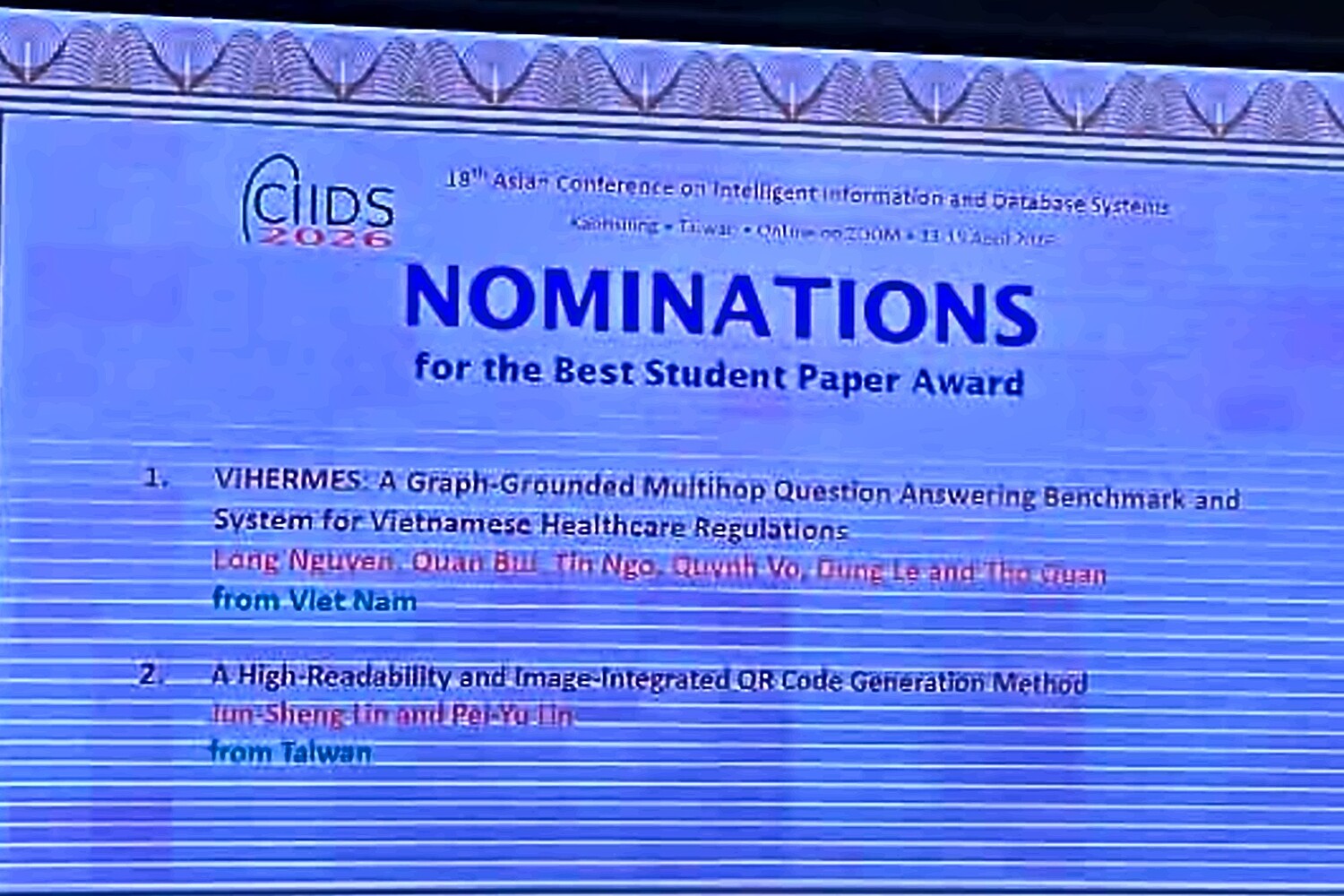
ACIIDS nomination
ViHERMES được đề cử Giải Bài báo sinh viên xuất sắc nhất · ACIIDS 2026ViHERMES nominated for the Best Student Paper Award · ACIIDS 2026
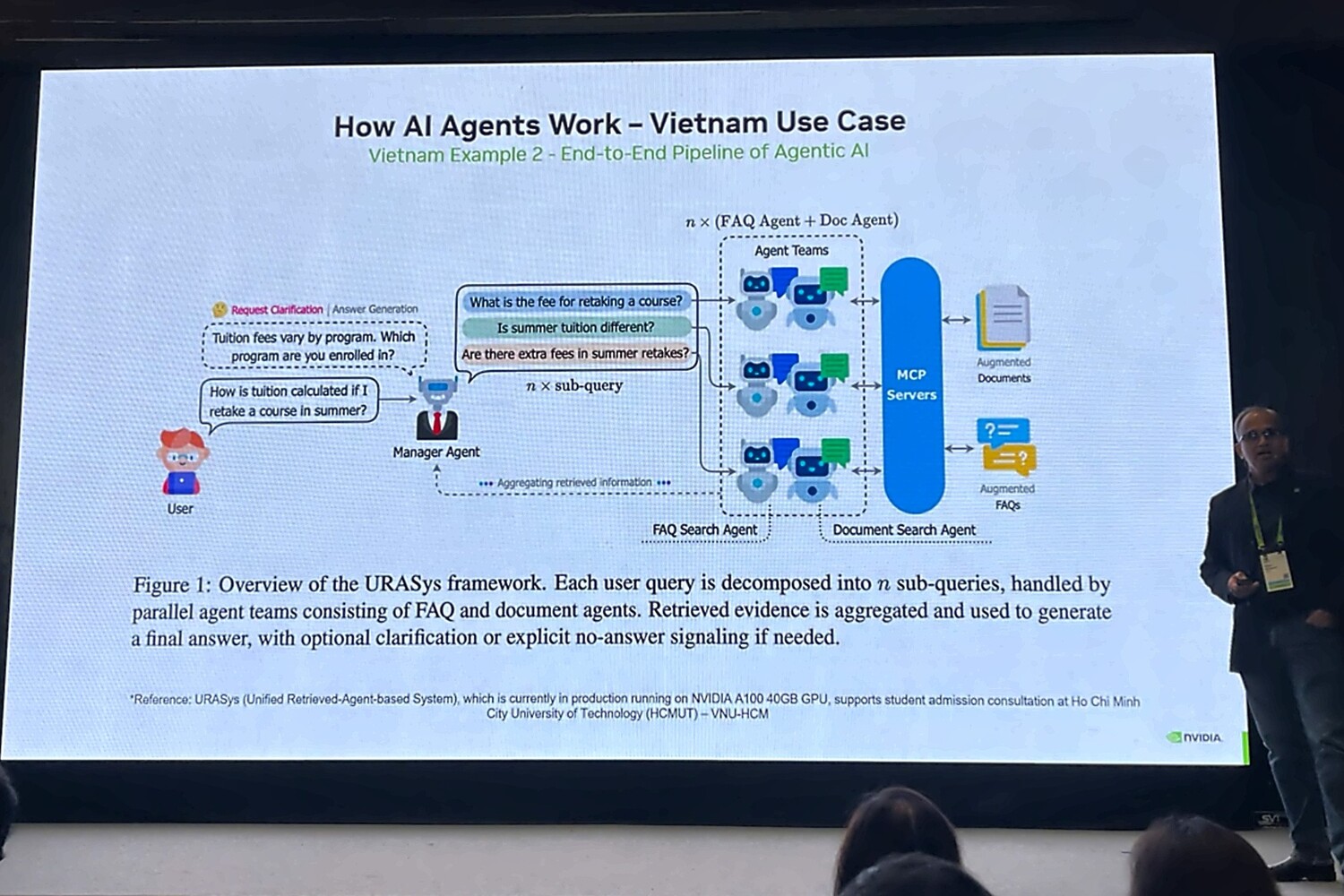
NVIDIA AI Day
NVIDIA giới thiệu URASys tại AI Day 2025, Thành phố Hồ Chí MinhNVIDIA showcased URASys at AI Day 2025, Ho Chi Minh City
Quốc tếInternational5 bài báo (1 CORE A, 4 CORE B), sinh viên là tác giả thứ nhất cả năm bài; một bài được đề cử giải bài báo sinh viên xuất sắc nhất.5 papers (1 CORE A, 4 CORE B), first author on all; 1 best student paper nomination.
Doanh nghiệpIndustryNVIDIA giới thiệu URASys là ví dụ tiêu biểu của Việt Nam về trí tuệ nhân tạo tác tử; Công ty YouthDev đưa vào ứng dụng, có giấy xác nhận.NVIDIA featured URASys as a Vietnamese agentic-AI use case; adopted by YouthDev with a written confirmation.
Nghiên cứuResearchĐược các nhóm nghiên cứu tại Trường Đại học Bách khoa – Đại học Quốc gia Thành phố Hồ Chí Minh, Trường Đại học Công nghệ Thông tin – Đại học Quốc gia Thành phố Hồ Chí Minh và Trường Công nghệ Thông tin và Truyền thông – Đại học Bách khoa Hà Nội sử dụng, có giấy xác nhận.Used by research groups at HCMUT (VNU-HCM), UIT (VNU-HCM) and the School of Information and Communications Technology, Hanoi University of Science and Technology, with written confirmations.
Cộng đồngCommunityHơn 1.100 lượt tải trên Hugging Face, hơn 390 lượt trong 30 ngày gần nhất.1,100+ downloads on Hugging Face, 390+ in the last 30 days.
Công bốPublications

Năm bài báo quốc tếFive international papers

Sinh viên là tác giả thứ nhất của cả năm bài. Bấm BibTeX để lấy trích dẫn.The student is first author of all five. Click BibTeX for the citation.

  1. EACL 2026 · CORE A Which Works Best for Vietnamese? A Practical Study of Information Retrieval Methods across Domains Long S. T. Nguyen, Tho T. Quan Paper · Code · BibTeX
  2. IJCNLP-AACL 2025 · CORE B When in Doubt, Ask First: A Unified Retrieval Agent-Based System for Ambiguous and Unanswerable Question Answering Long S. T. Nguyen, Quynh T. N. Vo, Hung C. Luu, Tho T. Quan Paper · Code · BibTeX
  3. ACIIDS 2026 · CORE B · ★ Đề cử Bài báo sinh viên xuất sắc nhấtBest Student Paper Nominee ViHERMES: A Graph-Grounded Multihop Question Answering Benchmark and System for Vietnamese Healthcare Regulations Long S. T. Nguyen, Quan M. Bui, Tin T. Ngo, Quynh T. N. Vo, Dung N. H. Le, Tho T. Quan Paper · Code · BibTeX
  4. PAKDD 2026 · CORE B A Benchmark for Structured Multihop Reasoning in Cross-Institution University Admission Advisory Question Answering Long S. T. Nguyen, Tin T. Ngo, Dung N. H. Le, Quynh T. N. Vo, Dung H. Nguyen, Khang N. Le, Tho T. Quan Paper · Data · BibTeX
  5. ICCCI 2025 · CORE B A Benchmark Dataset and Evaluation Framework for Vietnamese Large Language Models in Customer Support Long S. T. Nguyen, Truong P. Hua, Thanh M. Nguyen, Toan Q. Pham, Nam K. Ngo, An X. Nguyen, Nghi D. M. Pham, Nghia H. Nguyen, Tho T. Quan Paper · Data · BibTeX
Tham khảoReferences

Tài liệu tham khảoReferences

Các bộ dữ liệu và phương pháp được so sánh trong đề tài, trích từ danh mục tài liệu của các bài báo.Datasets and methods compared in this work, drawn from the bibliographies of the papers.

  1. [1]P. Lewis et al. 2020. Retrieval-Augmented Generation for Knowledge-Intensive NLP Tasks. NeurIPS.
  2. [2]S. Robertson, H. Zaragoza. 2009. The Probabilistic Relevance Framework: BM25 and Beyond. Foundations and Trends in Information Retrieval 3(4).
  3. [3]G. Salton, C. Buckley. 1988. Term-weighting Approaches in Automatic Text Retrieval. Information Processing & Management 24(5).
  4. [4]T. Formal, B. Piwowarski, S. Clinchant. 2021. SPLADE: Sparse Lexical and Expansion Model for First Stage Ranking. SIGIR.
  5. [5]O. Khattab, M. Zaharia. 2020. ColBERT: Efficient and Effective Passage Search via Contextualized Late Interaction over BERT. SIGIR.
  6. [6]G. V. Cormack, C. L. A. Clarke, S. Buettcher. 2009. Reciprocal Rank Fusion Outperforms Condorcet and Individual Rank Learning Methods. SIGIR.
  7. [7]H. Trivedi, N. Balasubramanian, T. Khot, A. Sabharwal. 2023. Interleaving Retrieval with Chain-of-Thought Reasoning for Knowledge-Intensive Multi-Step Questions. ACL.
  8. [8]P. Sarthi et al. 2024. RAPTOR: Recursive Abstractive Processing for Tree-Organized Retrieval. ICLR.
  9. [9]Z. Guo, L. Xia, Y. Yu, T. Ao, C. Huang. 2025. LightRAG: Simple and Fast Retrieval-Augmented Generation. Findings of EMNLP.
  10. [10]T. Fan, J. Wang, X. Ren, C. Huang. 2026. MiniRAG: A Lightweight RAG System with Small Language Models. ACL.
  11. [11]T. Xu et al. 2025. NodeRAG: Structuring Graph-based RAG with Heterogeneous Nodes. arXiv:2504.11544.
  12. [12]B. J. Gutiérrez, Y. Shu, Y. Gu, M. Yasunaga, Y. Su. 2024. HippoRAG: Neurobiologically Inspired Long-Term Memory for Large Language Models. NeurIPS.
  13. [13]B. J. Gutiérrez, Y. Shu, W. Qi, S. Zhou, Y. Su. 2025. From RAG to Memory: Non-Parametric Continual Learning for Large Language Models. ICML.
  14. [14]K. Van Nguyen, D.-V. Nguyen, A. G.-T. Nguyen, N. L.-T. Nguyen. 2020. A Vietnamese Dataset for Evaluating Machine Reading Comprehension. COLING.
  15. [15]K. Nguyen et al. 2022. VLSP 2021 – ViMRC Challenge: Vietnamese Machine Reading Comprehension. VNU Journal of Science: Computer Science and Communication Engineering 38(2).
  16. [16]K. Le, H. Nguyen, T. Le Thanh, M. Nguyen. 2022. VIMQA: A Vietnamese Dataset for Advanced Reasoning and Explainable Multi-hop Question Answering. LREC.
  17. [17]D. T. Do et al. 2024. A Summary of the ALQAC 2024 Competition. KSE.
  18. [18]Zalo AI Challenge. Legal Text Retrieval. Zalo AI.
  19. [19]K. Van Nguyen, T. Van Huynh, D.-V. Nguyen, A. G.-T. Nguyen, N. L.-T. Nguyen. 2022. New Vietnamese Corpus for Machine Reading Comprehension of Health News Articles. ACM TALLIP 21(5).
  20. [20]M.-N. Tran, P.-V. Nguyen, L. Nguyen, D. Dinh. 2024. ViMedAQA: A Vietnamese Medical Abstractive Question-Answering Dataset and Findings of Large Language Model. ACL Student Research Workshop.
  21. [21]T. Ngo, K. Dang, S. Luu, K. Nguyen, N. Nguyen. 2024. VlogQA: Task, Dataset, and Baseline Models for Vietnamese Spoken-Based Machine Reading Comprehension. EACL.
  22. [22]T. P. P. Do, N. D. D. Cao, N. T. Nguyen, T. Van Huynh, K. Van Nguyen. 2023. Machine Reading Comprehension for Vietnamese Customer Reviews: Task, Corpus and Baseline Models. PACLIC.
  23. [23]T. P. P. Do, N. D. D. Cao, K. Q. Tran, K. Van Nguyen. 2025. R2GQA: Retriever-Reader-Generator Question Answering System to Support Students Understanding Legal Regulations in Higher Education. Artificial Intelligence and Law.
  24. [24]P. Rajpurkar, R. Jia, P. Liang. 2018. Know What You Don’t Know: Unanswerable Questions for SQuAD. ACL.
  25. [25]Z. Yang et al. 2018. HotpotQA: A Dataset for Diverse, Explainable Multi-hop Question Answering. EMNLP.
  26. [26]D. Edge et al. 2024. From Local to Global: A Graph RAG Approach to Query-Focused Summarization. arXiv:2404.16130.